Training.

Our training programmes strengthen the skills needed to excel in competitive conkers. We are committed to bringing you cutting-edge nut tech, alongside world-class training techniques, to set you apart from your competition.

A hand holding a lace, with a painted conker hanging from it.

Technique.

Ten named strikes from the Conker Cup System of Competitive Striking (CCSCS), from the fundamental Classic to the specialist Expelliarmus. Ratings are out of 5.
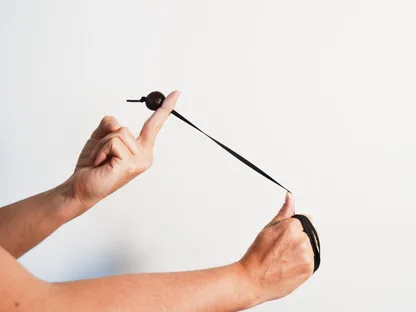
A hand with a lace wound round it, drawn taut to a conker held on the fingertip of the other hand.
  • The Classic

    Standard Pendular Strike

    Fundamental

    A compact pendular swing with minimal unnecessary movement, aimed at the upper hemisphere. The foundation technique: develop repeatable contact before increasing power.

    Power
    3
    Accuracy
    4
    Control
    5
    Preservation
    4
    Difficulty
    1

    Execution

    1. Establish a stable stance and the regulation lace length.
    2. Present the striking conker on the intended plane.
    3. Build velocity progressively rather than snatching at the movement.
    4. Keep your attention on the target region.
    5. Allow a controlled follow-through and recover your balance.
    Common errors
    Allowing the striking conker to drift across the target line; over-swinging; changing lace length during acceleration.
    Coaching note
    Practise at reduced speed first. Increase power only when you can reproduce the intended contact line without compensatory movement.
    When to use it
    Against a sound, neutral target, where the aim is reliable contact.
  • The Chopper

    Controlled Descending Strike

    Fundamental

    A descending attack converting a raised starting position into a direct strike on the crown or upper hemisphere. Particularly useful when the top surface is exposed.

    Power
    4
    Accuracy
    3
    Control
    4
    Preservation
    3
    Difficulty
    2
    Common errors
    Dropping the conker rather than accelerating it; excessive shoulder lift; striking too close to the aperture without assessing its condition.
    When to use it
    When the crown is exposed and the aim is to attack vertically.
  • The Side Swipe

    Lateral Power Strike

    Intermediate

    A lateral attack aimed at the equator, approaching from outside the holder's most familiar vertical line. Its advantages are power and an unexpected direction.

    Power
    4
    Accuracy
    2
    Control
    3
    Preservation
    3
    Difficulty
    3
    Common errors
    Sweeping behind the target; contacting with an excessive sideways glance; leaving insufficient clearance from the holder.
    When to use it
    When a lateral opportunity presents itself and the approach plane needs to change.
  • The Reverse Elbow

    Ascending Strike

    Advanced

    An ascending attack designed for the lower hemisphere, with power generated through coordinated rotation and upward movement. The arm starts straight and low, below the opponent's conker, held at the elbow, then swings upward. It is difficult to master and can lack power if mistimed, but is highly effective when executed correctly.

    Power
    4
    Accuracy
    2
    Control
    2
    Preservation
    3
    Difficulty
    4
    Common errors
    Flattening the path into a Side Swipe; beginning too close to the target; allowing rotational power to outrun accuracy.
    When to use it
    Against a weakness in the lower hemisphere, where the aim is to attack upward.
  • The Surprise

    Deceptive Initiation Strike

    Advanced

    A timing technique in which the start of the strike is deliberately difficult to read. Its value lies in disrupting anticipation rather than creating a new impact plane. Repeated use reduces its effect.

    Power
    3
    Accuracy
    3
    Control
    3
    Preservation
    3
    Difficulty
    3
    Common errors
    Adding theatrical movement that telegraphs the strike rather than concealing it; repeating the technique until it ceases to be a surprise.
    When to use it
    When the opponent is reading your rhythm and the aim is to disrupt anticipation.
  • Expelliarmus

    Full Rotational Displacement Strike

    Specialist

    A full rotational technique capable of substantial velocity and equally substantial variation. Reserved for experienced players. It concludes the Black String Examination, the highest grade in the Conker Cup String Grading System.

    Power
    5
    Accuracy
    1
    Control
    2
    Preservation
    1
    Difficulty
    5
    Common errors
    Insufficient clearance; loss of the target during rotation; uncontrolled release; assuming confidence is a substitute for alignment.
    When to use it
    Sparingly. CCSCS guidance is to reconsider tactical priorities before choosing it.
  • The Sniper

    Precision Exploitation Strike

    Specialist

    A reduced-energy precision strike aimed at a known crack or compromised region. The objective is fracture propagation rather than spectacle.

    Power
    2
    Accuracy
    5
    Control
    5
    Preservation
    4
    Difficulty
    3
    Common errors
    Aiming at the crack, then delivering the strike across the rest of the conker with excessive force.
    When to use it
    When a crack is visible and the aim is to exploit it precisely.

    Placeholder: video to follow.

  • The Sledgehammer

    Maximum-Energy Finishing Strike

    Specialist

    A long, uncomplicated power stroke for a target already judged ready to fail. It trades preservation and finesse for decisive energy.

    Power
    5
    Accuracy
    2
    Control
    2
    Preservation
    1
    Difficulty
    3
    Common errors
    Using it against a sound opponent without need; increasing the arc beyond your control; confusing effort with velocity.
    When to use it
    When the target is critical and needs force to finish.

    Placeholder: video to follow.

  • The Tap

    Controlled Preservation Strike

    Specialist

    A low-energy finishing strike used when the opponent is already critically compromised and the striker wishes to minimise damage to their own conker.

    Power
    1
    Accuracy
    5
    Control
    5
    Preservation
    5
    Difficulty
    2
    Common errors
    Insufficient energy.
    When to use it
    When the target is critical and the striker needs to protect their own conker.

    Placeholder: video to follow.

  • The Hook

    Oblique Flank Strike

    Intermediate

    A curved approach intended to reach a flank or rear-quarter weakness poorly aligned with a straight lateral attack.

    Power
    3
    Accuracy
    3
    Control
    3
    Preservation
    3
    Difficulty
    4
    Common errors
    Over-curving the path; contacting the lace; letting the curve turn into an ordinary miss.
    When to use it
    Against a rear-quarter weakness, where the approach needs to curve.

    Placeholder: video to follow.

Placeholder: a Technique Introduction video, and clips for The Sniper, The Sledgehammer, The Tap and The Hook, are to follow. They are not yet published on this site.

Product reviews.

You are only as good as the tech you are swinging. Conker Cup searches high and low for the latest in conker tech. We independently review and rate each piece of tech, so that you can make informed choices about the rig you want to swing with.

Conker rigs.

A rig is the lace, the knot and the conker a player brings together. Here is the equipment behind each part, and the rigs Conker Cup has laid out. How rig choice interacts with the rules is on The Game page.
The lace.

Round or flat, waxed or woven, rigid or elastic. A rigid lace favours precision; a compliant one absorbs. CCSCS calls this the Lace Trade-off. Laces listed in the Conker Cup Shop:

  • Dope Rope£9.99Oversized and comfortable to wrap around the hand. Used for training.
  • Glow Rope£4.99Conker Cup lace.
  • CSI Lace£4.99Conker Cup lace.
  • Pride Lace£2.99Rainbow flat sport lace.
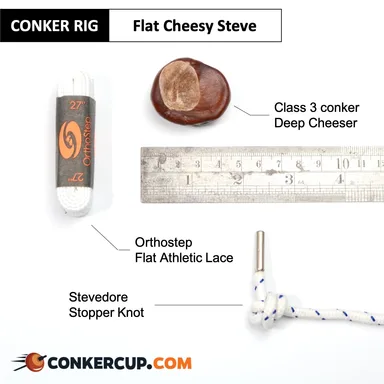
  • OrthoStep Flat Athletic£2.99Conker Cup Recommended. A flat, non-stretch, knot-retaining lace.
  • Stadux Waxed Round Lace£2.99Waxed, round.
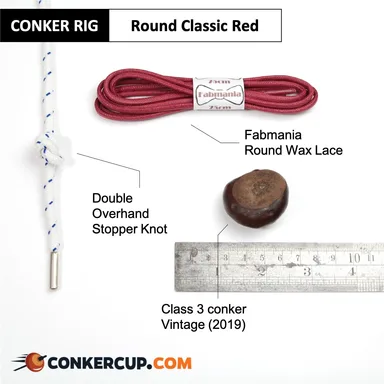
  • Fabmania Red£2.99Red. Fabmania also makes the round wax lace on the Round Classic Red rig.
  • Cubser Classic£4.99Cubser also makes the round laces on the Round Backstop and Screaming Wax rigs.
  • Miscly Round£2.99Round.
  • Miscly Round Boot Lace£4.99Round boot lace.

The rig cards on this page add Miscly Flat Elastic, Miscly Flat Black Lace, a bespoke round leather lace and plain parcel string. Prices are as listed in the Shop.

The knot.

The stopper is tied below the conker and has to hold through the swing, not only while the rig hangs still. The rig cards on this page show six.

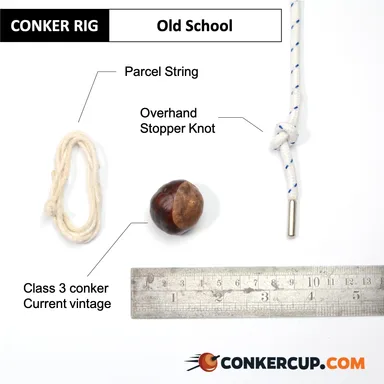
  • Overhand stopperOn Screaming Wax, PCC Leather Basic, Old School and Flat Overhand.
  • Double overhand stopperOn Round Classic Red.
  • Estar stopperRecommended as the most efficient stopper, particularly with a flat lace. On Estar Cheesy Bouncer and Flat COVID.
  • Stevedore stopperOn Flat Cheesy Steve.
  • Ashley stopperOn Round Backstop and Round Cheesy Boot.
  • Figure 8 stopperOn NHS R the Nuts.
  • ToggleFitted to the Dope Rope in place of a knot, for changing conkers quickly in training.

The conker.

Conkers are graded by size: Class 1 is the largest, Class 5 the smallest. Only conkers of sufficient quality are graded at all; the rest go unclassed.

  1. Class 1None shown
  2. Class 22 rigs shown
  3. Class 36 rigs shown
  4. Class 42 rigs shown
  5. Class 5None shown

Shape matters as well. CCSCS recognises four forms: round, cheese (flat), tall and irregular. The rig cards use the descriptions vintage, deep and rounded cheeser, and one rig is built on a pre-drilled conker.

More rigs in play.

Eleven rig cards in all, each laying out a lace, a stopper knot and a conker beside a ruler. Knots are demonstrated on a separate cord.
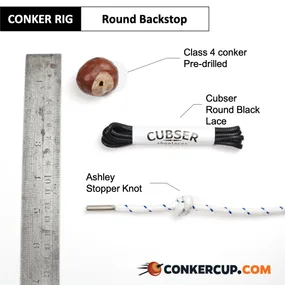
Round Backstop rig card: the lace, stopper knot and conker laid out beside a ruler.

Round Backstop

Lace
Cubser round black lace
Knot
Ashley stopper
Conker
Class 4, pre-drilled

Listed in the Shop as a rig, £4.99.
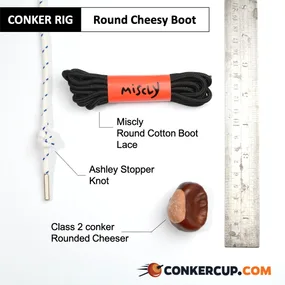
Round Cheesy Boot rig card: the lace, stopper knot and conker laid out beside a ruler.

Round Cheesy Boot

Lace
Miscly round cotton boot lace
Knot
Ashley stopper
Conker
Class 2, rounded cheeser
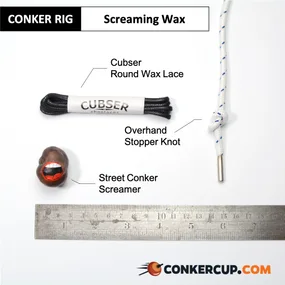
Screaming Wax rig card: the lace, stopper knot and conker laid out beside a ruler.

Screaming Wax

Lace
Cubser round wax lace
Knot
Overhand stopper
Conker
Street conker “Screamer”, unclassed
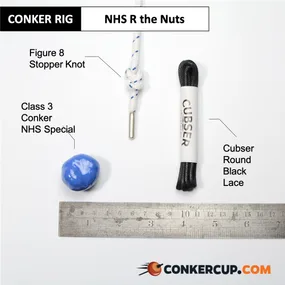
NHS R the Nuts rig card: the lace, stopper knot and conker laid out beside a ruler.

NHS R the Nuts

Lace
Cubser round black lace
Knot
Figure 8 stopper
Conker
Class 3, “NHS Special”
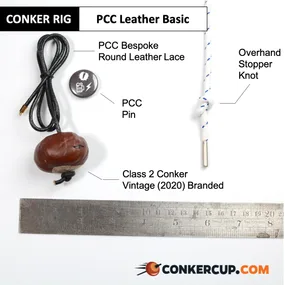
PCC Leather Basic rig card: the lace, stopper knot and conker laid out beside a ruler.

PCC Leather Basic

Lace
PCC bespoke round leather lace
Knot
Overhand stopper
Conker
Class 2, vintage 2020, branded
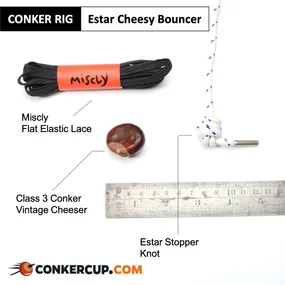
Estar Cheesy Bouncer rig card: the lace, stopper knot and conker laid out beside a ruler.

Estar Cheesy Bouncer

Lace
Miscly flat elastic lace
Knot
Estar stopper
Conker
Class 3, vintage cheeser

Listed in the Shop as a rig, £4.99.
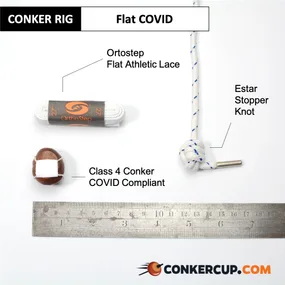
Flat COVID rig card: the lace, stopper knot and conker laid out beside a ruler.

Flat COVID

Lace
OrthoStep flat athletic lace
Knot
Estar stopper
Conker
Class 4, “COVID Compliant”
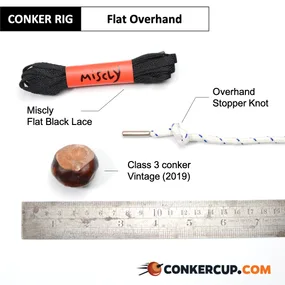
Flat Overhand rig card: the lace, stopper knot and conker laid out beside a ruler.

Flat Overhand

Lace
Miscly flat black lace
Knot
Overhand stopper
Conker
Class 3, vintage 2019

Counterfeit conkers.

Playing conkers out of season has always been a challenge for the nut sport industry. Aged nuts, although a little more shrivelled, can be used; however, typically these are saved for matches. Conker Cup has set about finding the best substitute conker for training purposes.

  1. Brussel Sprout

    Strong core, lots of leaf debris when contact is made.

    8.0/10
  2. Pickled Onion

    A solid performer, but messy set-up. Also it makes you cry!

    7.0/10
  3. New Potato

    Tends to shatter on impact, but get the right size and it feels like a conker.

    5.3/10
  4. Boiled Egg

    Very fragile and difficult to handle.

    2.0/10
  5. Baked Bean

    It's a baked bean, what did you expect?

    1.0/10