
The Game.
The Conker Federation officially recognises three versions of competitive conkers: Tournament, Street and Gentleman's. All three share the same foundations. Each has its own rules of engagement.
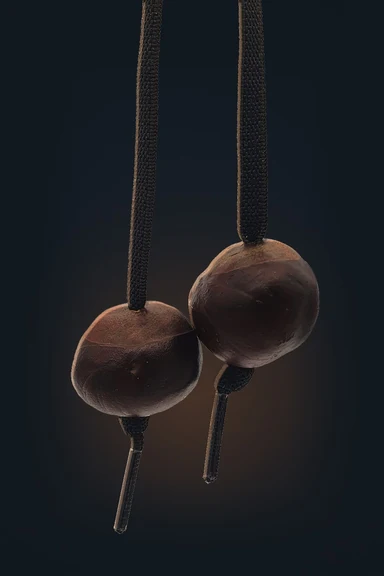
The Conker Rig.
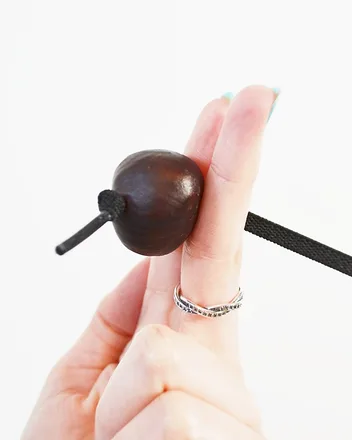
A rig is the working assembly of conker, lace and knot. Players build one for the conditions in front of them, much as a golfer chooses club, glove and ball for the shot.
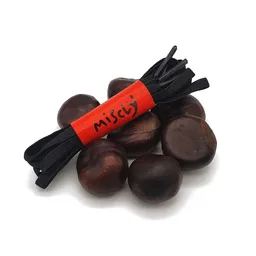
Lace
Carries the conker and transmits the swing. A rigid lace favours precision; a compliant one absorbs.
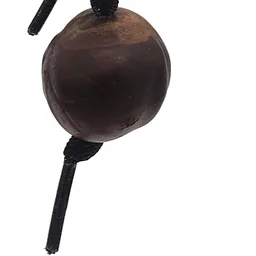
Knot
The stopper, tied below the conker. It keeps the conker on the lace and has to hold through the swing, not only while the rig hangs still.
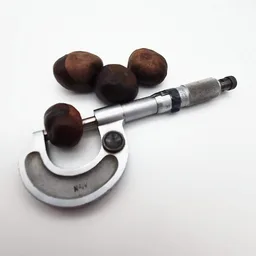
Conker
The striking mass. It is graded by size, and its shape and condition affect how it swings and how it holds up.
How the rules treat the rig.
- Tournament Conkers
- The rig is issued: a prepared Class 2 conker, drilled and strung on a regulation lace. With the equipment standardised, advantage has to be found in technique.
- Street Conkers
- The player's choice. Players select and prepare their own equipment, and local rules are agreed between them.
- Gentleman's Conkers
- Traditional equipment, on an 8 inch lace.
- Practice
- Free choice, as in Street Conkers.
The lace catalogue, knot types, conker classes and real rig examples are on the Training page.
Running a bout.
What every format shares: the roles, the conduct, and how a bout ends.
- Striker and holder
- The two roles alternate. The holder presents the conker at arm's length and keeps it still; the striker secures the lace, establishes the sanctioned length, aims and strikes.
- Don't Flinch
- The rule of conduct at the start of every bout. The holder keeps the conker still through the strike.
- Deliberate misses
- A deliberate miss is penalised with an additional strike awarded to the opponent.
- De-stringed
- A conker that is knocked clean off its lace, or whose lace is broken, and can no longer be swung. It is the defeat condition in every format.
- Auto-Nut Split
- If a striker's own conker splits on impact, the bout is an instant loss.

Tournament Conkers
A battle of skill. Everyone uses the same nut tech.

- How it starts
- The higher-scoring conker strikes first. If scores are level, including a none'er against a none'er, a coin toss decides.
- Equipment
- Conkers are issued, not brought. Current practice is a prepared Class 2 conker, drilled and strung on a regulation lace. A fundamental flaw is raised with the Nut Muster General before play, not corrected or quietly accepted.
- Lace length
- 20cm. The striker establishes the sanctioned length before striking.
- Strike pattern
- The Triple Strike Pattern: each player takes three strikes in turn before swapping. Adopted to align Conker Cup with the World Conker Championships, replacing the original Single Strike Pattern. It favours power over accuracy.
- Stringsies and stampsies
- Not permitted. If laces tangle, play is stopped and they are separated. A dropped conker is recovered without the opponent stamping on it.
- Switching conkers
- Each player selects one conker at the start of the match and plays with it throughout. In this year's straight-knockout format there is no switching.
- Match end
- A de-stringed conker loses the bout. If both conkers are de-stringed simultaneously, the bout is a draw.
The three-strike sequence.
Three strikes in turn is the format's law. The Conker Cup System of Competitive Striking (CCSCS) teaches a way to use them, as doctrine rather than rule: the first strike diagnostic, the second exploitative, the third decisive. Use the sequence; do not become a prisoner of it.
The Bonkers Minute.
If three minutes of play produce no result, the tiebreak begins.
- 3:00Regular play. No result.
- +1:00Players alternate strikes for a further minute.
- ResultIf neither conker is defeated, the higher count of successful strikes wins.
Street Conkers
A battle of wits. On the street, anything goes.
- How it starts
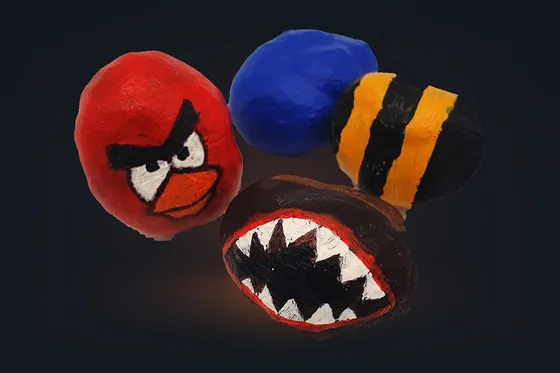
- Conkers are player-supplied and local rules are agreed between the players. Absent agreement, the higher-scoring conker strikes first, with a coin toss for equal scores.
- Strike pattern
- The Single Strike Pattern: one strike each before swapping. It is the original Conker Cup rhythm and favours accuracy over power.
- Match end
- A de-stringed conker loses the bout.
Stringsies and stampsies.
Both are permitted in Street Conkers.
- Stringsies
- If strings get tangled during play, a player may wrench to pull the conker from the opponent's hand, then stamp on it.
- Stampsies
- If an opponent drops their conker, or it is ripped from their hand, a player may stamp on it to break it.
Played year-round.
Tournament and Gentleman's Conkers follow the traditional autumn season that begins with the Nut Drop. Street Conkers does not. Players over-collect at the Nut Drop and play whenever they choose. The Conker Federation recognises the format formally, following its role in restoring participation after COVID.
Gentleman's Conkers
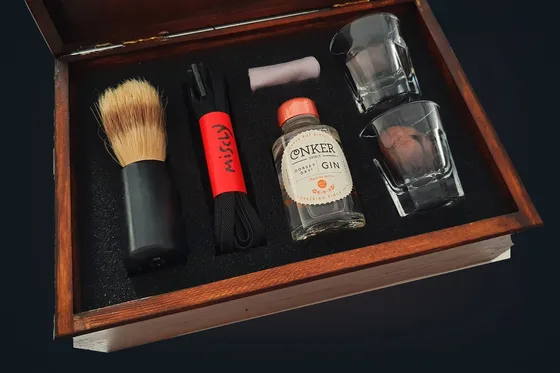
A civilised contest that always ends with a G&T.
- How it starts
- Modelled loosely on the etiquette of a duel: the competitor of greater seniority strikes first, following the opening procedure below.
- Lace length
- 8 inches.
- Strike pattern
- The Single Strike Pattern: one strike each.
- Stringsies and stampsies
- Not applicable. There is no wrenching or stamping in the Gentleman's Game.
- Match end
- The match is over when one conker is de-stringed. Both players shake hands and say, “Ruddy good show.”
The opening procedure.
- The competitors stand back to back.
- Each walks five steps forward and four back.
- They shake hands.
- The more senior competitor takes the first strike; each player takes one.
- When one conker is de-stringed, both players shake hands and say, “Ruddy good show.”
The Conker Gin.
Win or draw, the match concludes with both players retiring for a gin and tonic. The tonic is interchangeable. The gin must specifically be Conker Gin.
Scoring.
Every conker carries a score. It begins at none and grows with each conker it defeats.
None'er
A conker's starting rank, held before it has won a bout.
One'er
The rank a none'er becomes after beating another none'er.
Er Rating
A conker's score: how many other conkers it has beaten, counted by the formula below.
New score = own score + defeated conker's score + 1
0 + 0 + 1 = 1A none'er beats a none'er and becomes a one'er.
3 + 12 + 1 = 16A three'er defeats a twelve'er and becomes a sixteen'er.
Conker Rings.
Physical rings, rated 01, 05, 10, 20 and 50, worn on a conker to show its accumulated score at a glance. Peckham Conker Club pioneered them in 2021 and Conker Cup adopted them the same year. Defeat a ringed conker and its rings are yours to claim.
- 01
- 05
- 10
- 20
- 50